
Taste Guide: Carcavelos Wine Cask
Carcavelos is a fortified wine from Portugal. Of the four major Portuguese fortified wines (Port, Madeira, Moscatel de Setúbal and Carcavelos), it is certainly the least well-known and, in any case, the rarest. This is not due to its quality, which is highly regarded among connoisseurs, but primarily because the DOC of the same name, located north of the Tagus estuary and west of Lisbon, where it is produced, is the smallest in Portugal with just 32 hectares of vineyards (!)
Carcavelos is a blend of up to 8 different white and red grape varieties. The finished wine must contain at least 75% of the white varieties Galego Dourado, Ratinho, and Arinto, as well as the red varieties Castelão and Preto Martinho. The remaining 25% is divided between the white wine varieties Rabo de Ovelha and Seara Nova, as well as the red Trincadeira. The grape yield is limited to 55 hectolitres per hectare. The blending ratio and the vinification process, particularly for the red wines, vary from producer to producer, meaning that a Carcavelos can differ both in taste and colour. The colour spectrum, which also depends on the degree of ageing and oxidation, ranges from light cognac to dark brownish-red. The most common colour of a mature Carcavelos is a rich tawny.

The production of this wine differs significantly from that of other sweet wines: the individual grape varieties are harvested separately and vinified dry. The treatment of the red grapes, particularly the duration of maceration, varies, which has a significant influence on the final product in terms of colour and flavour. Part of the must (usually that of the particularly sweet white Galego Dourado – known as vinho abafado) is transferred to small barrels whilst still partially fermented and immediately fortified to preserve the residual sweetness. Once fermentation is complete, the wines are blended, the sweet must set aside earlier is added, and the cuvée is fortified to at least 16%, but usually 19–20% by volume with pure ethyl alcohol. It is then aged in small oak barrels for at least three, but usually five years or longer, before being bottled and stored for at least a further six months before going on sale. Currently, a maximum of 40,000 litres of this wine are produced annually.
A Carcavelos can be vinified as dry, semi-dry or semi-sweet; most modern products are semi-dry. It displays aromas of nuts, vanilla, tobacco, almonds and dried fruit, and has a good acidity profile. It is somewhat reminiscent of a good Tawny Port, with which this type of wine was also blended in earlier times.(From Wikipedia, the free encyclopedia)
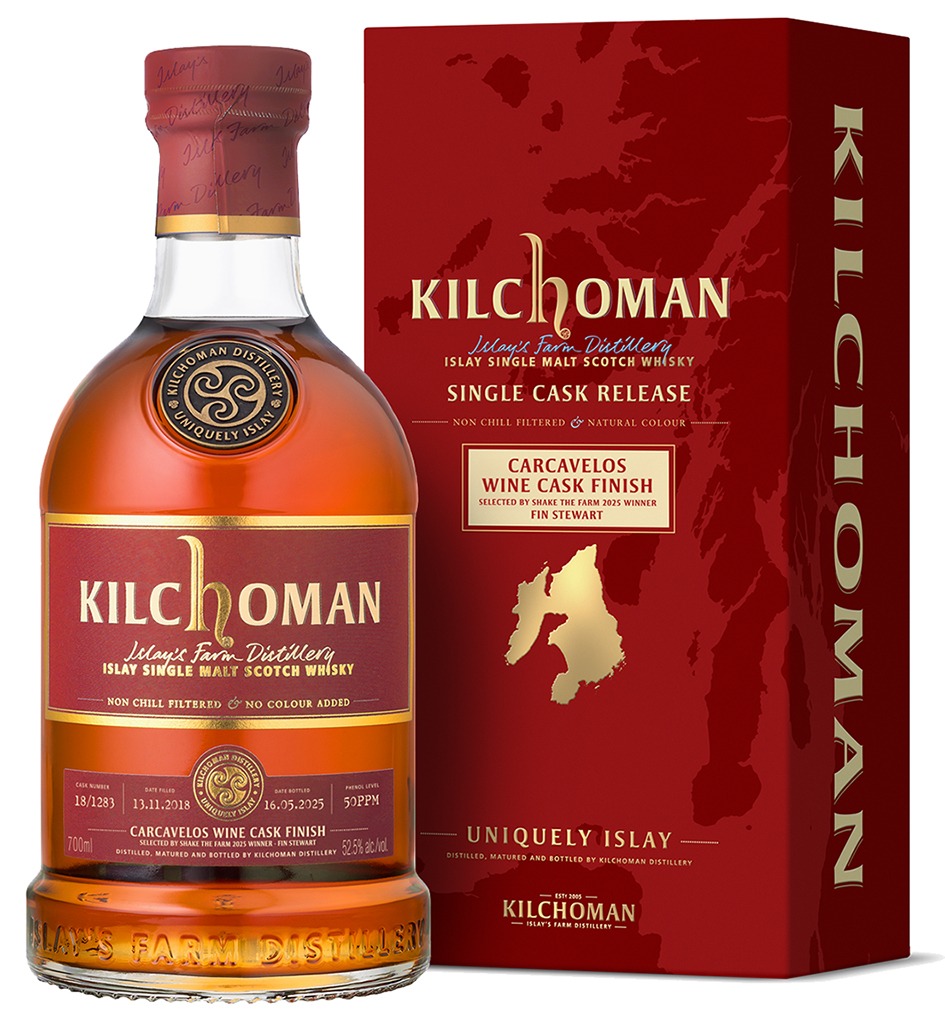
Carcavelos wine casks are extremely rarely used in the whiskey industry. This is certainly due primarily to the relative obscurity of this fortified wine and the limited availability of the casks. However, the Kilchoman Distillery, which had already had very positive experiences with the other three Portuguese fortified wines and with fortified wines from other countries—such as Maury, most recently—was able to acquire a few Carcavelos casks from a Portuguese cooperage a few years ago.
The first single cask bottling, a Carcavelos Wine Cask Finish, was bottled on 16 May 2025. Fin Stewart, the winner of the Shake the Farm Cocktail Competition, which Kilchoman had organised for the second time in 2025, was able to select a Kilchoman cask for the UK market and chose this new cask type.

Another Carcavelos Wine Cask Finish followed on 28 May 2026 as the ‘Be a Bottler’ cask from the event of the same name at the Kilchoman Open Day during the Fèis Ìle 2026. At 24 months, this had more than twice the finishing period of the Shake the Farm cask, which made the whisky taste considerably fruitier without any unpleasant tannic notes.
Since September 2026, Kilchoman has been using another of its handful of Carcavelos casks for the ‘Warehouse Tastings’ and has been selling 10-cl samples of it at the visitor centre as part of the so-called ‘Warehouse Exclusives’. This cask, numbered 1278/2018, underwent a finishing period of 26 months.
.
Kilchoman Carcavelos Wine Cask releases:
| Release | Cask No. | Date Filled | Date Bottled | Maturation |
|---|---|---|---|---|
| Carcavelos Wine Cask Finish selected by Shake the Farm 2025 Winner – Fin Stewart | 1283/2018 | 13.11.2018 | 16.05.2025 | Finish: 11 months |
| Carcavelos Cask Finish “Be a Bottler 2026” | 1216/2018 | 30.10.2018 | 28.05.2026 | Finish: 24 months |
| Carcavelos Cask Finish – Warehouse exclusive | 1278/2018 | 13.11.2018 | 09/2026 | Finish: 26 months |
.