
Taste Guide: Bourbon Cask
As is the case with many whisky distilleries, casks that previously held bourbon whisky are by far the most important type of cask used for whisky maturation at Kilchoman. Approximately 70% of Kilchoman’s annual production is matured in ex-bourbon casks.
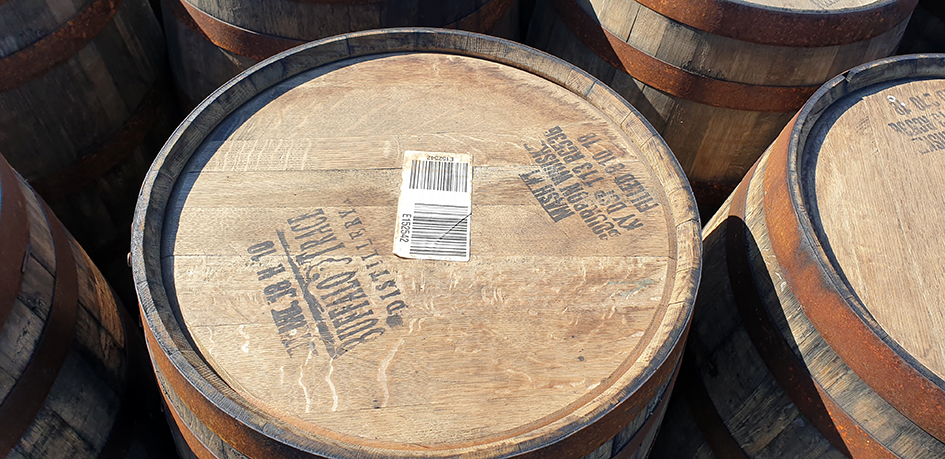
Whilst Bourbon barrels and hogsheads were initially sourced from a cooperage, thanks to the mediation of the well-connected Dr James Swan, the renowned Buffalo Trace Distillery in Kentucky was secured as a cask supplier. For over 15 years, this type of cask was sourced exclusively from Buffalo Trace. These were exclusively first-fill ex-bourbon barrels of the highest quality grade offered by Buffalo Trace. These were filled a maximum of twice by Kilchoman.
.
.
This not only ensured the high quality of the casks used – one of Jim Swan’s key requirements for producing a high-quality, fast-maturing whisky – but also allowed for a consistency in cask material that larger distilleries can only dream of. As is well known, the sherry casks (butts and hogsheads) are sourced exclusively from the Bodega Miguel Martin in Jerez, Spain, following the same principle.
A very consistent cask quality not only facilitates cask management, but the frequency of quality checks on the maturing distillate can be determined very precisely without having to worry too much about ‘outliers’; furthermore, the vatting of larger releases, such as Machir Bay, which, as is well known, are bottled as batches of dozens of casks, can be carried out quite strictly ‘to recipe’, ensuring a consistent flavour across the core brands with relatively little effort.
As is well known, Kilchoman releases countless single cask bottlings every year. No other distillery offers such a clear insight into the maturation of the spirit over the years of its development. A consistent source of casks is also extremely helpful in this regard. Bottlings from casks filled in 2006 vary significantly more in quality than is the case with all later Kilchoman bottlings, not least due to the heterogeneous origin of the casks. Of course, there are outliers here not only at the lower end of the spectrum, but certainly also at the higher end. A good example is the sister casks 03/2006 and 05/2006. The bottling of the latter is regarded by Kilchoman connoisseurs as one of the best Kilchoman releases matured in bourbon casks, whilst the former exhibits off-notes that I have not encountered in any subsequent Kilchoman whisky.
What does Kilchoman whisky matured in bourbon casks taste like?
Even after just 3 years – the point at which the distillate is permitted to be called whisky – the whisky is already astonishingly delicious and extremely easy to drink. The high quality of the first 3-year-old Kilchoman bottlings not only astonished whisky fans in 2009, but also laid the foundations for Kilchoman’s subsequent success story.
A distinct but not overpowering note of peaty smoke (“bonfire on the beach”) – now regarded as typical of Kilchoman – sets the tone for an olfactory and gustatory experience that is then dominated by very fruity notes, “cooked yellow fruits” and citrus, as well as malty tones, to which, with age, increasing vanilla notes from the bourbon casks are added. This general description holds true up to an age of approximately 6–8 years, and as all three of Kilchoman’s General Releases are of this age, it serves as something of a description of Kilchoman’s house style. As the whisky matures further, the fruitiness changes: the “cooked yellow fruits” (i.e. pear and apple) increasingly give way to peach and apricot, the vanilla notes intensify, and the first subtle woody notes become apparent. From around 10–12 years, the fruit notes then shift further towards tropical fruits (mango, pineapple); according to Anthony Wills, the ‘sweet spot’ is reached at 12–14 years. After that, the woody notes become increasingly noticeable.
The pattern I have described applies to the widely used first-fill bourbon barrels; with second-fill barrels, the development is generally somewhat delayed and the whiskies matured in them often appear significantly sweeter.